Pages

Showing posts with label CD. Show all posts

Monday, February 28, 2022

From One Elvis Collection To Another

An Elvis collection for sale.

The other day my wife notified me of the following post on Facebook by our local record store:
We have received a collection with over 400 used CD records by Elvis! Come on in and take a look!
Studying the post and the accompanying photo of the collection, I decided to take a look at it in person. So away I went, nearly rushing to the store, half expecting all those Elvis records being surrounded by fans like myself. 

Of course that wasn't the case. But approaching the shelves with the Elvis CD's, I spotted an older couple looking at them, the man uttering something like "Are all those records really by Elvis?" Turning to them I responded cleverly, "There can never be too many Elvis albums," which earned me a smile from the woman. 

I then turned my attention to the collection, examining the CD's. The majority of them were RCA/BMG albums, but I also noticed some of the earlier FTD releases as well as a couple of bootlegs. A closer look revealed a few Japan pressings as well. As I've always had a soft spot for Japanese Elvis Presley releases, I picked them up (among them was On Stage, one of my favorite Elvis albums).

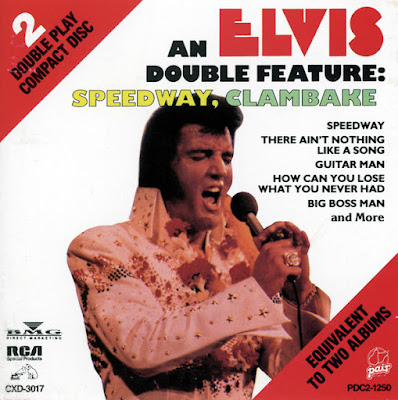
The CD An Elvis Double Feature: Speedway, Clambake was released in 1989.

As an afterthought, I also grabbed a strange looking release titled An Elvis Double Feature: Speedway, Clambake boosting a picture from the Aloha show on the cover. However, it only featured 16 songs in total, that is, eight songs from each movie album, respectively. Strange, indeed. 

As I was about to pay for the CD's, I asked the saleswoman if the collection was from someone who had passed away, and she told me it was. Just like me, she thought it a bit sad but also "good that those albums get a new home." I agreed, went home and added them to my collection. In these troubled times, it felt good to spend a little time with Elvis.

Saturday, January 15, 2022

He Touched Me – Undubbed Version?

Front cover of the He Touched Me album.

Having listened to the undubbed Christmas masters from Elvis Back In Nashville all through the Holidays, I decided to turn my attention to the undubbed religious masters on the same CD set.

Just like the Christmas masters, the track order is identical to the original album, in this case He Touched Me released in 1972. The exception is "Amazing Grace" which is included on disc one among The Country/Folk Sides. 

But unlike the Christmas material, the religious songs were recorded with background singers present in the studio. Most of the tracks were then left undubbed for release on the He Touched Me album. I guess this was a decision on producer Felton Jarvis part, mimicking the sound of Elvis singing gospel privately with his friends and backup singers to help unwind after a show.

A look in my well thumbed copy of Elvis Session III by Joe Tunzi revealed that only four of the religious songs on the He Touched Me album were overdubbed: "Amazing Grace" and "I, John" (both with more backup vocals), "He Is My Everything" (with strings) and "A Thing Called Love" (with strings and horns). 

Back cover of He Touched Me.

Still, I was looking forward to the whole undubbed He Touched Me experience, and it started well. The title track and album opener was as moving and soothing as ever, and the sound crystal clear. 

Then followed the more modern up tempo Christian number "I've Got Confidence," sounding fantastic with the electrical guitar more prominent and the song lasting about 25 seconds longer than on the original album, with frantic hand clapping and the band cooking. What a treat! (I recognized snippets of Elvis' voice at the end used to great effect on the version featured on the Where No One Stands Alone album released a couple of years ago, featuring new backing music and vocals.)

Next up was another pleasant surprise. Usually, when I listen to "Amazing Grace," I almost wonder if Elvis is there at all due to all the backing vocals. But in the undubbed format, I noticed that Elvis voice was more up front and the background singers more in the, well, background. The whole thing sounded so much clearer and less muddled. 

I then turned my attention to "Seeing Is Believing," with electrical sparks flying from James Burton's guitar. As always, it reminded me of  "I've Got Confidence," and I noticed another extra seconds at the ending here as well. I bet the writer of the song, Red West, was in the studio listening. How exciting it must have been for him to hear this. 

I was then unexpectedly disappointed. While I listened to "He Is My Everything" without the strings, I noticed that the original backing singers were gone, too. Slightly confused and irritated, my spirits lifted with the help of the next track, "Bosom Of Abraham." I always find it irresistible and infectious, reminding me of some of the spirituals on Elvis' earlier religious albums. The interaction between Elvis and the Imperials is pure joy. 

"Bosom of Abraham" was released as single together with "He Touched Me" in March, 1972. Interestingly it was titled "The Bosom Of Abraham."

In my imagination, I then flipped the album to the B-side. The two first numbers, "An Evening Prayer" and "Lead Me, Guide Me" sounded beautiful as always, maybe even more so in this new mix. But then surprise och disappointment struck again. As was the case of "He Is My Everything," the background vocals had been eliminated on "There Is No God But God." Although a pleasant enough song, in my opinion it really benefits from the backing vocalists responding to Elvis' singing. 

Fortunately, the rest of the tracks from "He Touched Me" were left undubbed as they were recorded in the studio. "A Thing Called Love" without the strings and horns worked well, even though bass singer Armond Morales' vocals were mixed down (in the original recording he is singing in union with Elvis throughout the song). "I, John" sounded more like a gospel quartet song without the overdubbed female singers and "Reach Out To Jesus" ended with the passionate ending I remember so well.

Two more religious tracks were recorded during the Nashville sessions 1971, and they are included after the "He Touched Me" tracks. "Put Your Hand In The Hand" and "Miracle Of The Rosary" were eventually saved for Elvis Now ("Amazing Grace" replaced "Miracle Of The Rosary" when no Folk album materialized), but it's evident they would have fit on Elvis' third religious album as well.

All in all, I enjoyed the undubbed version of He Touched Me. But it annoyed me that two of the tracks had their backing vocals removed. It also rhymes badly with what is written in the booklet:
NOTE: As the vocal interaction between Elvis and the backing singers is deemed fundamental to the gospel performances, they have been left as originally intended by Elvis and A&R man Felton Jarvis.
So, to sum it up. You now have two options to experience the He Touched Me album. You can either listen to the original album, with four overdubbed songs and the eight remaining tracks undubbed, or you can pick the one offered on the Elvis Back In Nashville set with all twelve tracks undubbed but two of them with the original backing singers removed. 

Additional reading:

Friday, December 24, 2021

Christmas Songs For You From Elvis

Front cover of Elvis Sings The Wonderful World of Christmas.

Elvis' Christmas songs always play an important role in getting into the Christmas spirit for me. This is especially helpful when living in Gothenburg, Sweden, where rain is more common than snow in the winter. So, since the beginning of December, I have been busy playing the undubbed Christmas tracks on the recently released Elvis Back In Nashville 4-CD set featuring his 1971 Nashville recordings.

Listening to them for the first time, I was reminded of my review of the FTD's treatment of Elvis Sings The Wonderful World Of Christmas, released ten years ago. I looked it up, and, among other things, this is what I had to say:

With the help of outtakes not being overdubbed in any way, it reveals a more intimate and sensitive side of the Christmas recordings that took place in Nashville during two nights in May, 1971. 

The same holds true for the Christmas masters, that without overdubs, form a softer and gentler version of the 1971 seasonal album, as my brother wisely points out in his recent review of the Elvis Back In Nashville set (the track order is the same as on Elvis Sings The Wonderful World Of Christmas). One such an example is "On A Snowy Christmas Night," where an organ and some beautiful acoustic guitar playing that was buried in overdubs on the original release, lends the song a more delicate feel. 

In the same way, "It Won't Seem Like Christmas (Without You)" and "Holly Leaves And Christmas Trees" both work extremely well undubbed, sounding more sorrowful than before. Even the bombastic "If I Get Home On Christmas Day" offers a more sincere listening experience without the strings, horns and backing vocals producer Felton Jarvis used when making the overdubs 50 years ago. 

Elvis as santa on the cover of the single "Merry Christmas Baby."

One of the highlights on the original album is the blues classic "Merry Christmas Baby," and finally we get the complete unedited and undubbed version. For some inexplicable reason, the unedited version released on FTD's Elvis Sings The Wonderful World Of Christmas switches to the original album master mix (with a guitar overdub) approximately four and a half minutes into the song, and then back again to the undubbed mix about one minute and ten seconds later. 

The rehearsal part found on the FTD version is also included on Elvis Back In Nashville, and this is what I wrote about it in my original review in 2011: 

Listening to Elvis saying "Yeah, just run it a couple of times and I'll come in there, you know, somewhere. Let's set the rhythm first," it's easy to imagine him in the middle of the studio with a mike in his hand, his musicians in a semi-circle around him.

Another favorite from Elvis Sings The Wonderful World Of Christmas, and one that I rank among the best Christmas songs Elvis ever recorded, is Michael Jarrett's "I'll Be Home On Christmas Day." I have always had a soft spot for the bluesier June remake version, and that one is included on the Elvis Back In Nashville set as well.

This is what the songwriter Michael Jarrett had to say about Elvis approach to his song, in an interview I did with him in the beginning of 2012:

I believe he approached my song in his own special way, that is to say; he related to what the lyrics were saying and the overall sentiment the song conveyed to him during this time of his life. I believe he chose the song to record because it had personal meaning to him.

"O Come, All Ye Faithful" was the B-side of the single "Merry Christmas Baby."

One song that I actually think benefits from the overdubs Felton Jarvis did is "O Come, All Ye Faithful." Granted, the organ that is now more prominent lends the song a more sacred feel. But I miss the choir as well as the original voices that sang the song with Elvis (unidentified, but most likely Charlie Hodge and Red West). Together with the strings and horns they make the song so much more mightier and powerful.

I still remember buying Elvis Sings The Wonderful World Of Christmas on cassette in the early eighties, then playing it in my room on my new cassette recorder. I shared my memories of that in a post published in Deecember, 2010:

Listening to the cassette, I was mesmerized by Elvis' singing, hearing for the first time the title track as well as the bombastic "If I Get Home On Christmas Day" and the incredible "Merry Christmas Baby."

Some 40 years have passed since I first heard Elvis singing about the wonderful world of Christmas, and every year I return to it so that Elvis can help me get into the Holiday mood. This year was no exception, but a little different, listening to it in another format without all the overdubs. It worked just as well, though, and with that I'd like to take the opportunity to wish you all a Merry Christmas.  

Additional reading:

Sunday, November 28, 2021

Guest Blog: Elvis Back In Nashville – A Review


The natural follow-up to last year's From Elvis In Nashville 4-CD set is out, and although I haven't yet received the physical product, I've listened quite a lot to it on Spotify. Containing masters and outtakes from Elvis’ 1971 Nashville session, Elvis: Back In Nashville presents the 43 masters on the first two CD’s and the outtakes on the final two discs.

The sound is great, no doubt about it. Instruments that previously have been buried in the mix now sound crystal clear. The drums in ”It's Only Love” for example, without the horns to drown them out, are really moving the song forward.

I've always had a soft spot for these 1971 recordings. Elvis' voice is not as good as in 1970, actually it is sometimes quite weak, but it morbidly fits well with so many of these lost love/broken man songs. Like on ”I'm Leavin’,” one of my favorite Elvis recordings. So I was so much looking forward to this box set.


The idea of presenting the tracks without overdubs, as they were recorded in the studio, is a great one. Many of these songs were really suffering from overuse of horns and strings (although one could argue that they were recorded with overdubs in mind). And I have no problems either with new mixes, making some instruments more prominent than before, and some less so.

But on the first CD the producers have made a strange decision: About half of the masters are presented with the background singers removed. Yes, the singers that were in the studio with Elvis! This was one of the big differences compared to the 1970 Nashville sessions where no other singers than Elvis and Charlie Hodge were present. And now, The Nashville Edition, The Imperials, Mille Kirkham and the Holladays, are gone.

If this had been properly made, maybe I could have accepted it. But often the background singing is bleeding through, and with earphones you sometimes can hear it quite clear. It's like it's there, but far, far away. And even without the bleeding-through, this makes for some strange listening. On ”The First Time Ever I Saw Your Face,” Ginger Holladay is very much audible during the false start. Then during the master, she is not there anymore.

The first CD actually reminded me of the two Our Memories of Elvis albums from 1979 where the same kind of removal mixes were made. It didn't make sense then, and it doesn't make sense now.


It's a greater delight to listen to the second disc, with songs that would form the albums Elvis Sings The Wonderful World Of Christmas and He Touched Me. The background voices are luckily intact on the gospel material and a lot of the instruments that you couldn't hear before are really up front. "I've Got Confidence" really rocks! The background singers were not present during the recording of the Christmas songs (I guess the Christmas tree that was put up in the studio took up too much space!) and without overdubs, the songs form a softer and gentler version of the 1971 seasonal album. Unlike some of the folk and pop tracks from CD 1, the Christmas recordings often work without additional singers.

The outtakes discs (where the producers thankfully have not removed the background singers) work well, although there are too many false starts and too much studio banter to really make it a great listening experience. But there are some gems here, including a previously unreleased take on one of the best Christmas songs, Michael Jarrett's ”I'll Be Home On Christmas Day.”

In all fairness, the big problem with this release is the first CD. Unfortunately, that was the disc I looked forward to the most, as it collects all the pop and folk masters from these sessions for the first time. The undubbed Christmas masters are, a bit surprising, the big win for me, and I will play that portion of CD 2 a lot come Christmas time.

Despite my objections, it's terrific that box sets like this are still produced. However, I hope the producers get it together for the next volume in this series, containing Elvis' 1972 and 1975 masters. I have a great title for that release: Back In Hollywood (Well, he was there a lot in the 60's, right?). And an advice: Do not remove instruments and vocals recorded in the studio. Please.

/MÄrtenbrother

Additional reading:

Saturday, October 2, 2021

Amazing Grace: Elvis Back In Nashville

The bluesy take 2 of "Amazing Grace" is the third digital single promoting the Elvis: Back in Nashville set due for release on November 12.
Barely had I written about the second promo/preview/digital single from the upcoming 4 CD set Elvis: Back In Nashville when the third one was released yesterday. This time the spotlight is put on the first (incomplete) and second take of "Amazing Grace." Take 2 was first made available on the Walk A Mile In My Shoes – The Essential 70's Masters back in 1995, while the whole sequence containing both takes found its way onto the FTD version of He Touched Me (2011).  

I actually reviewed the latter in a post here on my blog back in November 2011 (was it really that long time ago?!), so I revisited that and read what I had written about the two first takes of "Amazing Grace." Apparently I focused a lot on the studio banter: 

Another example is the banter before the second take of "Amazing Grace" (following the first abandoned one) which has Elvis saying "I hit the wrong words, I was singing 'Love Me Tender'," and one of the musicians answering, "You was singing the hell out of it, whatever it was." I think he's right. I actually prefer the bluesy take 2 over the more conservative master.

Listening to the audio promo today made me realize this still holds true. Ernst Jorgensen puts it well in his excellent book Elvis Presley: A Life In Music (1998):

For this voice piece the rhythm section set a slow, solid, unobtrusive beat, while Chip Young added some bluesy acoustic slide guitar and David Briggs contributed flashy piano runs straight out of the showy gospel music tradition. 

But for some reason, after the second take producer Felton Jarvis told Chip Young to run a straighter course, resulting in a more traditional master of the song (take 5). For the first time this can now be heard on the promo (it wasn't included on FTD's version of He Touched Me). The dialogue runs something like this:

Felton Jarvis: Chip, don't play that funky stuff there man, really just straight.

Chip Young:  Alright.

Felton Jarvis: Simplicity you know.

Then another person says: Jerry, you're not gonna play on your kick drum, are you?

Jerry Carrigan: Ah, not much, no.

The other person: OK. 

So there went the bluesy version out of the window in favor of the master that we know from the He Touched Me album. I like that one too, but take 2 has the edge. In my book, yet another excellent choice to help promote Elvis: Back In Nashville.

Additional reading:

Wednesday, September 29, 2021

Until It's Time For You To Go: Elvis Back In Nashville

"Until It's Time For You To Go" (take 5) has been released as an offical lyric video.

So far I have been pleased with the the audio promos/digital singles RCA have chosen to promote the upcoming Elvis: Back In Nashville 4 CD set. In August the first attempt of the stunning "I'm Leavin'" was released (including a new rehearsal part), and a month later we were treated with take 5 of the beautiful "Until It's Time For You To Go." 

I thought it would be interesting to see what some of my favorite Elvis books have to say about "Until It's Time For You To Go" that was originally released as a single in January 1972, coupled with "We Can Make The Morning." First out is Robert Matthew-Walker and his book Elvis Presley: Studies in Modern Music (1979):

"Until It's Time For You To Go" became a classic hit for Presley and this performance is one of his best. He infuses each word with an added meaning.

In 1982 a book called The Complete Elvis edited by Martin Torgoff came out. Among other things, it included an A-Z section, that my brother and I loved to study. Today he sent me a mobile photo of what was written about "Until It's Time For You To Go":

Elvis turned Buffy's 1970 version of her own folksy composition into a ballad with piano and strings nicely complemented by the Imperials. The lyrics are stretched and phrased beautifully. 

Moving on to my well thumbed copy of Elvis Presley: A Life In Music from 1998 (if I could keep only one of my Elvis' books this would be the one) Ernst Jorgensen paints this picture of the recording of "Until It's Time For You To Go" on May 17, 1971:

Buffy Sainte-Marie's "Until It's Time For You To Go" was the next folk number to which Elvis gave his full attention. This kind of material might have been suitable for a pop album, less so for a single – but Elvis was throwing himself into his performances with abandon now, and all anyone could do was stand back and watch.

It's obvious Elvis cared for "Until It's Time For You To Go." Not only did he try to better his May version with a remake of the song at the June sessions (although it was the May recording that was eventually chosen for release as a single), he also included it in his live repertoire. 

I have to confess I like it too. It's a tender song that always strikes a chord when I listen to it. That leaves you, dear reader. What do you think of Elvis' version(s) of "It's Time For You To Go"? 

Additional reading:

Tuesday, July 6, 2021

"It Was A Helluva Show"


I have a confession to make. The last couple of years my pile of unopened FTD concert releases has gotten higher and higher. Therefore, two days ago, on July 4, I thought the timing just right to remove the shrink-wrap from the Elvis: The Bicentennial Show 2 CD set released in 2017 and listen to CD 1 and Elvis' performance in Tulsa on Independence Day, 1976.

Before pressing the play button I checked out the review of this release on the Elvis Information Network, where it had this to say about the sound quality:

Tulsa was recorded on reel-to-reel and so would sound fabulous, as did the July 3rd Fort Worth soundboard, were it not for some awful distortion. While it can be interesting to hear alternate mixes with various instruments high in the mix, the Tulsa show sounds terrible for having James Burton’s guitar wound up ridiculously high and so distorted. Obviously his guitar level was way over-driven on the original recording and it sounds terrible. 

Surely it can't be that bad, I thought, but it was. Which is a shame, as the show is a pretty good one, including highlights such as "America," "An American Trilogy," "Hurt" (sung twice) and "How Great Thou Art." And judging by the screaming fans it must have been an exciting way to spend the Fourth of July that particular year. This is what Bill Donaldsson of the Tulsa Tribune had to say about Elvis' performance:

He gave his fans about the best concert any pop singer can. He sang songs ranging back to the beginning of his career, several new ones, and he didn't shortchange the faithful. Remarking that he had only one show to do Sunday, and therefore could extend his performance, the star held the stage for more than an hour. [...] If Presley repeats with the same voltage he displayed this time around, his devoted fans will be fully repaid for their efforts to get those tickets. It was a helluva show.

Elvis concluded this particular tour in Memphis the very next day, on July 5, with a great show. Maybe it was the fact that it was an evening show and not an afternoon show like the one in Tulsa, maybe is was because it was Elvis' home town. Probably it was a combination of both. Elvis is focused, is clearly having fun on stage and delivers such gems as "Softly As I Leave You," "One Night," "Blue Christmas" and "That's All Right."

The Memphis show has been bootlegged twice on CD, and the sound quality is very good (with James Burton's guitar exactly where it should be in the mix). Had I been at the helm of the FDT label,  I would have included this concert as CD 2 on the Elvis: The Bicentennial Show instead of the one from Duluth, October 16, 1976, that was RCA's Joan Deary's initial choice for the 1980 box set, according to the before mentioned review on the Elvis Information Network. 

Or come to think about it, the best thing would probably have been to swap the order of the CD's and rename it Elvis: Mid-South Magic or King Of Rock 'N' Roll Day (as proclaimed by then Memphis Mayor Wythe Chandler). Including the Tulsa show as kind of a bonus CD due to the terrible mix would have been a more logical move, at least in my book.

That said, the shrink-wrap has been removed and I have finally listened to Elvis: The Bicentennial Show. I wonder what concert will be next?

Additional reading:

Saturday, June 19, 2021

What If: Celebrating My Birthday In Memphis, June 10, 1975

Elvis on stage in Memphis on June 10, 1975. I turned eight that day.

Last week, on June 10, I listened to the second CD on the FTD release Elvis Hometown Shows, featuring Elvis' 1975 concert in Memphis. It seemed appropriate. Not only was it my birthday, but the show was performed on that date as well, although 46 years ago. I was in Sweden celebrating my eighth birthday at the time, but imagine if I had been in the Mid South Coliseum instead. To borrow a phrase from fellow blogger Tyggrius who runs the Mystery Train Blog: You've just crossed over into ... the edge of reality.

My parents had been Elvis fans for as long as I could remember. I grew up listening to them talking about how great he was and there wasn't a day when one of this records wasn't on the turntable. And they must have told the story of how they met a hundred times. Would you believe it was outside the cinema after watching the Swedish premiere of Blue Hawaii on March 31, 1962, with their respective friends?

Five years later, on June 10, 1967, I was born. To celebrate, my dad gave my mom a copy of the Double Trouble album that had been released just a couple of days earlier. So "Old MacDonald" was probably one of the first Elvis songs I heard, together with the rest of the tracks on that LP. My mom later confided in me that she wasn't overly impressed with it at the time, but that it has remained special to her all the same. Like me.

A couple of days after my fifth birthday, in 1972, my parents bought me my first Elvis album ("A late present" they called it). It was a brand new copy of the Elvis As Recorded At Madison Square Garden recorded on my birthday, June 10, and rush released just eight days later. It was love at first sight. One of my earliest memories is holding the cover in my hands and thinking Elvis looked like a superhero. I don't remember the first time I listened to it, but my parents do. Apparently I was moving around a lot to the music with a big smile on my face, enjoying every second of it. I still do.

Three years later I guess you could call med a full-fledged Elvis fan. I listened to all the new releases my parents bought, read the fan club magazines they subscribed to and dreamed of seeing Elvis in concert. My two-year younger brother couldn't understand what all the fuzz was about, and neither could my three-year younger sister. My youngest brother, just three years old, showed some promise, though, clapping his hands every time I played an Elvis record.

With my eighth birthday just a couple of days away, my parents told me they had a surprise. As Elvis' latest single "T-R-O-U-B-L-E" was blasting through the speakers, they asked me to turn the volume down. "We are flying to Memphis in two days, and you are coming with us. You are going to see Elvis perform on your birthday in Memphis."

Mid South Coliseum, June 10, 1975.

When I think back on my journey to Memphis, some memories are crystal clear while others are faded or a bit sketchy. I don't remember much of the actual flight or the hotel where we stayed but thankfully a lot from the actual concert is still vivid in my mind: all the cars and people outside the Mid South Coliseum as we arrived, the excitement in my parents' eyes as the first notes of "Also Sprach Zarathustra" sounded through the building, Elvis entering the stage in his Indian feather suit and so many flashbulbs going off it looked like daylight. 

Another thing I will never forget was the screaming fans, my mom among them. "We love you, Elvis!" she shouted at the top of her lungs more than once. I think my dad was close to screaming, too.

As for the show, I remember bits and pieces, like Elvis throwing his guitar at a guy on stage (Charlie Hodge) who dropped it. I also recall Elvis kissing a lot of girls during "Love Me," and handing out plenty of scarves as well. My parents later told me he ripped his suit during this song, and joked about it throughout the concert, something I didn't notice. I guess my English wasn't as good as I thought it was.

Two songs I clearly remember that he sang was the rockers "Burning Love" and "T-R-O-U-B-L-E" as those were among my favorites at the time (they still are). Before the show I told my parents I hoped he would perform them and he did. The extended endings of both songs were so exciting!

If I close my eyes I can also see most of the people in the audience clapping their hands during the chorus of "How Great Thou Art" and maybe half the audience standing. When he finished the song everyone was at their feet and they would not stop applauding. That I will never forget. 

A funny thing is I don't remember the final part of the concert or Elvis leaving the stage. But that's OK. My parents and me shared an incredible experience together with the other 12,364 people in the audience that night. It remains the best birthday I have ever had.

Back in this universe, my parents met under completely different circumstances. I became a fan after one of my brothers bought an Elvis album in the late 1970's, and I first laid eyes on the Mid South Coliseum during a trip to Memphis and Graceland in 2005. But that's another story.  

Additional reading

Saturday, April 10, 2021

Guest Blog: From Elvis In Nashville – A Review


Ever since I got Rough Cut Diamonds in 1985, I’ve longed for this release. Not that I didn’t enjoy the 1985 bootleg album, I thought it was great to hear the 1970 studio masters without all the strings, horns and vocal overdubs that were present on – and in some cases more or less ruined – the songs. But the sound quality was pretty rough (!), there were still fade-outs and there were so many more songs from the Nashville marathon sessions. I wanted it all.

I was eleven years old when I got Rough Cut Diamonds. Now I’m 48. Has it been worth the wait? Well, I would say it has. The sound quality is top notch. And the new mixes sometimes almost transform the songs. I’ve always found "Got My Mojo Working" a bit dull, or as Elvis himself says just after recording the song: "We grew up on this mediocre shit." But through Matt Ross-Spangs’ mixing, with the organ much more prominent, it almost sounds like a new song. It definitely kicks more ass.

Another fine track in which the organ takes a more dominant part is "Funny How Time Slips Away." It just soars, and makes this recording even more haunting. And to think they nailed it in only one take! That is actually the case with several of the songs presented here.

There are some great moments on this album that weren’t on the original releases: Elvis’ fantastic vocalising in "I Washed My Hands In Muddy Water," the end of "When I'm Over You" where he (almost) starts from the beginning again, and the over and over ending of "The Sound of Your Cry," where Elvis sings like he just has to get the chorus out of his system. And for the first time on an offical mainstream release, we get to hear some of The King’s creative swearing. He was a human being, after all.

Sometimes I miss the overdubs, like the backing vocals in "Twenty Days and Twenty Nights," but that is not very often. This is how these songs should sound, and should have sounded when released back in 1970–1971.

One thing that does annoy me is that the songs in many cases still fade out in the end. Especially on disc three and four which contain outtakes, that could have been avoided. In the mini documentary The Making of From Elvis In Nashville (see below), producer Ernst Jorgensen says that the idea of this release is to hear what it would have been like sitting in the studio with Elvis and the band. Well, the fades were made afterwards and kinda contradict Jorgensen’s claim. And when, which is also the case on disc one and two (which contain the masters), you get some dialogue before the songs, the idea to fade them out doesn’t make any sense.

But that is really the only thing I don’t like about this release. From Elvis in Nashville contains great music, with Elvis and the band in great form. Pure Elvis country soul! I would have loved it back in 1985. And I love it now.

/MÄrtenbrother

Thursday, April 1, 2021

Elvis Las Vegas 1975: April Fool's Dinner

Today I punched the date April 1, 1975 into my time machine and attended Elvis' dinner show at the Las Vegas Hilton showroom. Actually, I went there twice.

THE AUDIENCE RECORDING

The first time around I found myself seated at the end of one of the tables located perpendicular to the stage. In front of me was an Elvis souvenir menu. I absentmindedly ordered a "Seafood Cocktail Supreme" that was promptly delivered before the lights dimmed to the sound of "Also Sprach Zarathustra" blasting through the room.

Glancing at the guy sitting opposite me, I saw him fiddling with something under the table. Leaning over and taking a closer look, I realized he was pressing the play and recording buttons on a portable cassette recorder. Looking up at me, he smiled and made a "shusing" gesture, holding his index finger in front of his mouth. I smiled back and handed him the menu. Gratefully, he placed it over the cassette recorder so only the part featuring the microphone was visible.

When Elvis entered the stage he looked a little heavy, but the voice was stronger than ever. As for the show, it was a no nonsense, contemporary affair, with highlights like "And I Love You So," "Big Boss Man," "My Boy" and "Fairytale." Almost all of the quick renditions of songs from the 50's were gone, except "Hound Dog." Obviously, he took his singing seriously.  

At the same time, Elvis was in good spirit, joking and interacting with the audience, clearly enjoying himself. ("Oh yeah, the second part of the show has been cancelled, so ... April fool!") As for me, I sat so close to the stage that I could clearly make out the pattern of the light blue and silver ornaments on the shoulders of his two-piece suit.

All too soon, though, it was over. "It's been a pleasure working for you, so 'til we see you again, take care, God bless you," Elvis told the audience, before launching himself into "Can't Help Falling In Love." I could be mistaken, but before the curtains came down, I am pretty sure he smiled right at me. 

The last thing I saw before travelling back to 2021 was the guy with the cassette recorder hiding it from security. It would eventually find its way to a bootleg LP released in 1980 with the title Rockin' With Elvis April Fool's Day, and later on with upgraded audio on the bootleg CD April Fool's Dinner from 2009.

THE SOUNDBOARD

The second time I punched the date April 1, 1975, I was aiming for the midnight, closing show that took place a couple of hours later. But somehow I must have messed up the time control, as I was transported to the afternoon show once more. Only, this time, I found myself standing in the back of the showroom, next to sound engineer Bill Porter and his mixing console. 

Wearing a checkered jacket and with a TCB necklace around his neck he was clearly frustrated over something, turning knobs and pressing buttons. But as the lights dimmed and I once more heard the the iconic opening of "Also Sprach Zarathustra," I turned my attention to what was happening on stage instead.

This time, the details of Elvis' two-piece suit weren't as recognizable as before, nor was his face. That didn't stop me from feeling that he sang for me and no one else. By the look of the mesmerized faces around me, I was pretty sure everyone in the audience felt the same way.

At the end of "See See Rider" Elvis said quickly in his microphone, "I can't hear on stage, Bill." As I casted a glance to the side, I noticed Bill Porter adjusting a couple of fader controls. That seemed to satisfy Elvis, who soon found himself busy responding to someone on the balcony shouting several times, "Look up here!" 

But clearly something else was wrong, as Bill Porter muttered to himself, "The soundboard recording has stopped." He continued to press buttons and turning knobs, and just as Elvis ended "I Got A Woman/Amen," I saw relief in his face. Clearly, the recording of the soundboard was back on track.

"Love Me" and "If You Love Me (Let Me Know)" followed, and a couple of songs later it was time for a nice surprise. Dropped two years ago from the set list, "Burning Love" was back again, and Elvis delivered a great, funky version. "I'll Remember You" and "How Great Thou Art" at the end of the show were strong performances, too. 

Before returning to 2021 a second time, I saw Bill Porter pressing down a button on the mixing console as the closing vamp came to an end, stopping the recording of the soundboard. It would take 41 years before it surfaced courtesy of the FTD label in 2016, on the second disc of the double 5" release titled Elvis Las Vegas 1975 (featuring the March 22 midnight show on the first disc). 

You could to worse than pick it up and travel back in time, like I did today. But if you want to experience the balcony dialogue as well as "I Got A Woman/Amen," you will have to find the bootleg version instead.

SET LIST, APRIL 1, DINNER SHOW

01. Also Sprach Zarathustra (missing on the audience recording)
02. See See Rider
03. I Got A Woman/Amen (missing on the soundboard)
04. Love Me
05. If You Love Me (Let Me Know)
06. And I Love You So
07. Big Boss Man
08. The Wonder Of You
09. Burning Love
10. Introductions
11. My Boy
12. I'll Remember You
13. Let Me Be There
14. How Great Thou Art
15. Hound Dog
16. Fairytale
17. Can't Help Falling In Love
18. Closing Vamp

Additional reading:

Friday, August 16, 2013

The Stax Trilogy


Each year on August 16 I try in my own way to celebrate the legacy of Elvis Presley, and most of the times it involves listening to some carefully picked Elvis music during the day. This time around, inspired by the recent Elvis At Stax release, I will play songs from the three Follow That Dream classic albums making up what I like to call “The Stax Trilogy,” that is, Raised On Rock, Good Times and Promised Land (the first one recorded in July 1973 and the last two in December that year).
 
Not only do these three titles represent some of the best releases from the FTD label so far, they also feature a lot of my favorite tracks with Elvis, (both masters and alternate takes) and this is especially true when it comes to the two albums recorded in December 1973.  Also, they are good examples of albums where Elvis’ ability to master all kind of musical styles, such as pop, rock, ballads, country funk and gospel, is clearly evident.

I also like the fact that the outtakes on the FTD classic album version of Raised On Rock present the Elvis’ 1973 July recording session at Stax in a much more positive light than was the case on the original 1973 album. That said, Raised On Rock clearly is the weakest of the bunch, and although not anywhere near Good Times or Promised Land, it would have made for a stronger album had Elvis not insisted on “I’ve Got A Thing About You Baby” and “Take Good Care Of Her” be taken of the album for a future single release instead.

Finally, I’d like to share a comment my brother MĂ„rten made when I posted my review of the FTD classic album version of Good Times in 2009, where he responded to another well written comment (by the signature David) ending with the line “Taking the best from each one of these two albums [Good Times and Promised Land] would have resulted in one of the very greatest albums of his career - in hindsight, if only quality was more important than quantity.”

This is what MĂ„rten wrote: “I've always thought about what a great 12 track album we could have had from the December 1973 sessions. Here is my versions of it (Leaving of Help Me b/w If That Isn't Love for an Easter 1974 single and the rest of the tracks as B-sides for singles):

Side A
Talk About The Good Times
If You Talk In Your Sleep
Loving Arms
You Asked Me To
Thinking About You
It’s Midnight

Side B
Promised Land
There’s A Honky Tonk Angel
I Got A Feeling In My Body
Your Love’s Been A Long Time Coming
My Boy
Good Time Charlie’s Got The Blues

Listening to those 12 tracks will be as good start as any to commemorate Elvis, don’t you think?

Further reading:

Thursday, August 16, 2012

Treat Me Nice


Ten years ago, on August 16, 2002, an one hour radio program titled
Treat Me Nice was aired on nationwide radio in Sweden. Having produced and recorded the program a couple of days earlier, I remember how excited and proud I felt reading about it in one of the biggest newspapers in the morning (the text was a shortened version of the press release) and it read something like this:

On August 16 it is 25 years since Elvis Presley died. Still, Elvis is more alive today than ever. No one has more organized fans and Graceland is the most visited private home in the USA after the White House. Elvis records are selling like never before and this summer he has been number one in the charts [with the JXL remix of “A Little Less Conversation”]. More about this can be heard in the program Treat Me Nice, where Thomas Melin takes a closer look at the phenomenon of Elvis.

Listening to the program today (I have a copy of it on CD, of course), it hit me how much of what I included in it still holds true. Ernst Jorgensen is still searching for unreleased Elvis material and the demand for alternate takes, home recordings and live versions is as high as ever. Books about Elvis continues to be written and Elvis Week only seems to be getting bigger and bigger every year. And Elvis keeps performing “live on screen” accompanied by his old band members (although it might be for the last time during tonight's Elvis 35th Anniversary Concert in Memphis).

At the end of the program, I asked Ernst Jorgensen how big he thought the interest in Elvis would be in another 25 years. His answer was that Elvis will probably sell fewer albums as the music gets older, but that he will not be forgotten.

Ten years later, it is still great times to be an Elvis fan. The official collectors label Follow That Dream Records continues to serve us with unreleased material and their latest release, the book and 3 cd set A Boy From Tupelo : The Complete 1953-55 Recordings is truly remarkable. And then there is the Sony October release Prince From Another Planet 40th Anniversary Madison Square Garden 2 CD/1 DVD set to look forward to.

On a completely different level, this marks my 500th post since I started the Elvis Today Blog exactly five years ago, on August 16, 2007. Something that would have never been possible without the support of my readers. To all of you I express my gratitude. But most of all, thank you Elvis, for always being there for me with your music. It means the world.

With this post I'm taking an indefinite break from blogging. There is so much going on in my life at the moment, at the top of the list is my two year old daughter, I simply haven't got either the time or energy to write about Elvis. But I will continue to listen to the man who, like Troy Y. over at The Mystery Train Blog puts it so well, provides the soundtrack to my life.

Wednesday, August 8, 2012

From Hawaii To The Rest Of The World

What if the previously unreleased cassette recording of Elvis rehearsing the day before his opening show at the Las Vegas Hilton on January 26, 1973 had been a rehearsal for an upcoming world tour instead? In an alternate universe, a review of the recently released From Hawaii To Las Vegas album from FTD would have sounded a bit different. To borrow a phrase from fellow blogger Troy Y: You've just crossed over into ... the edge of reality. 

Fortunately Elvis didn't return for another routine engagement in Las Vegas after his triumphal Aloha From Hawaii Via Satellite show. As you all know, he went on a highly successful world tour instead, starting in Europe. The recent From Hawaii To The Rest Of The World release from Follow That Dream Records provides an unique “fly-on-the-wall” experience of Elvis rehearsing for his opening show in London. Captured on a personal tape recorder, the sonic quality is below normal standards, but historical significance more than compensates for its audio limitations.

The first two songs on the cassette recording are “Something” and “You Gave Me A Mountain,” both sounding very much like their counterparts from the satellite show. As Aloha From Hawaii served more or less as a blueprint for the song list included on the world tour, Elvis probably rehearsed “See See Rider” and “Burning Love” as well, before someone pressed the “record” button.

The third song, “Steamroller Blues,” is the extended version we know so well from the first world tour. Elvis sings the “I'm a napalm bomb” verse two times, first time low and bluesy right after the guitar solo, the second time in the same exploding style as the last “I'm a steamroller baby” verse. No wonder this became a firm fan favorite during the tour. 

My Way” is again very similar to the version from Hawaii, except for some clowning around with Charlie Hodge during the first verse. Then it's time for “Love Me” and “It's Over.” “Love me till it's over,” Elvis jokingly says before delivering a straight forward “Love Me” that ends with the orchestra playing a few bars of The Star-Sprangled Banner, evoking laughter from the band and musicians. “It's Over” is a nice version, every bit as beautiful as the one from the Aloha concert. 

Blue Suede Shoes” is a one minute throw away version, involving some uninspired singing from Elvis part. Thankfully, it always sounded much more full of energy when performed during the shows abroad. A far better rehearsal is “I'm So Lonesome I Could Cry” featuring the additional verse heard on the world tour as well. One of the highlights on the CD.

Listening to the rehearsal of “Welcome To My World” took me back to the time I saw Elvis perform in Paris for the first time (the soundboard from that concert was made available by FTD on the album Paris '77 a few years ago), the giant pictures of Graceland projected behind Elvis as he was singing the song. I remember it sent shivers up my spine.

Elvis then discusses the order of some of the songs to be performed on the opening show, among them “Hound Dog,” “What Now My Love,” “Fever” and “Suspicious Minds,” neither of which are rehearsed. (But listening to them on the Elvis Recorded Live On Stage In London album, it's obvious they turned out all right all the same.)

The ending of “I'll Remember You” causes the orchestra some problems. “I thought that was bad enough,” Elvis mutters after an abandoned attempt. After they finally get it right, Elvis launches himself into a driven and rockin' medley of “Long Tall Sally”/Whole Lotta Shakin' Goin' On.” Not only is this version one minute longer than the one from Hawaii, it's also much better, sounding very much like the one found on the Live On Stage In London album (although that one of course lasts for about five minutes). 

An American Trilogy” always evoked great response, not only in the southern states, but also when performed all throughout Europe and then the rest of the world during 1973. Listening to the powerhouse version on From Hawaii To The Rest Of The World it's easy to understand why. Similarly, the rehearsal of “A Big Hunk O' Love” gives you an idea of why everyone stood up and clapped their hands when this rock 'n' roll oldie was belted out by Elvis in arenas all around the world.

The catchy “I'm Leavin It Up To You” was always a highlight during the first world tour, but the rehearsal reveals that the song almost didn't make it to the set list. Lasting only for about 43 seconds, Elvis cuts it short with the words “That's all. Let's do 'Faded Love'.” Someone then asks him why he stopped, receiving the answer, “It was written with a pen. I couldn't read it.” Thankfully, someone must have produced typed written lyrics and convinced Elvis to rehears it again (after the cassette tape ended).

Just like “I'm Leavin' It Up Top You,” “Faded Love” wasn't performed on the Aloha From Hawaii show. But luckily Elvis choose to retrieve this number from his 1971 Elvis Country album. It was then regularly performed during the following world tour, the rehearsal reminding me of the version recently released on the FTD treatment of Live In Australia.

The rehearsal of “I Can't Stop Loving You” is a near copy of the version found on Aloha From Hawaii Via Satellite. Not bad, but far more interesting are the two versions of “Separate Ways,” one with just the band and the other with band and orchestra. Always an emotional moment when performed during the first world tour, one can hardly dare to think about what a loss it would have been if Elvis had chosen not to try the song in front of an audience. Just listen to the heartbroken version included on the Elvis Recorded Live On Stage In London album and you'll understand what I'm talking about.

Another highlight during Elvis' first world tour was of course “Bridge Over Troubled Water,” and it's nice to listen to a rehearsal of it, even if the live versions available all sound much more exciting. “Let's do 'Can't Help Falling In Love' and we can call it off,” Elvis then tells the band before the From Hawaii To The Rest Of The World release ends with an (incomplete) version of the show closer we all know so well. To think that Elvis didn't change that one until 1977!

To sum it up – From Hawaii To The Rest Of The World is an essential release. Granted, the sound quality leaves a lot to be desired, but as a historical document it's priceless. This is how Elvis worked with his repertoire up to the last moment before leaving for his opening show in London.

Back in this universe, I'd like to recommend From Hawaii To Las Vegas as well. It's certainly not everyday a rehearsal turns up like this. But what a strange experience it must have been for Elvis to return to doing routine shows in Las Vegas after the Aloha From Hawaii success just a few weeks earlier. What if the satellite show had been followed by a world tour instead. One can only dream.

This post is dedicated to Troy Y. who runs The Mystery Train Blog.

Sunday, July 29, 2012

Following That Dream (Part 4)

The fourth and last part of the article "Following That Dream," that I wrote for the Elvis International magazine, takes a closer look at the “what if” albums released by FTD.

The album that could and should have been,” Ernst Jorgensen writes in the booklet accompanying FTD’s Standing Room Only, and he’s right. The decision to release Burning Love And Hits From His Movies Vol. 2 instead was both dumb and inexcusable. But 37 years later, in 2009, FTD aimed to put things right. The label’s version of Standing Room Only combines the Las Vegas masters from February 1972 with the studio masters recorded the following month. The second CD consists of outtakes from the March studio session.


The second album “that never was” is titled Elvis Sings Memphis, Tennessee. It was recorded by Elvis in Nashville in May, 1963 and January, 1964, but for different reasons didn’t see the light of day until 1990 when it was released as For The Asking – The Lost Album in Europe. (When released in the U.S. in 1991 it was titled just The Lost Album.) What FTD did in 2008 was to release all the original masters and alternate takes from these two sessions on 2 CD’s. In 2011 the same formula was used with Elvis Sings Guitar Man, the third “what if” album that included songs recorded in Nashville as well, masters as well as outtakes, this time from the period 1966-1967.

One of the highlights on the Elvis Sings Guitar Man album is the making on the title track from the September 1967 session. Listening to Jerry Reed taking command of the recordings is fascinating stuff, as is the studio banter between him and producer Felton Jarvis. And that brings me back to what I really enjoy the most about the releases from FTD; to listen to how Elvis approached his work, and in that way learn more about him as an artist and a performer To read about it is one thing, to listen to what actually took place when it happened is a completely different ball game.

I’d like to end this article with something I wrote for my blog last year after having listened to the recording of “Guitar Man” on Elvis Sings Guitar Man. Combining what I heard in my headphones with facts and memories from those who that were there (described in books by, for example, Ernst Jorgensen and Peter Guralnick) and by using a bit of imagination, I came up with the following.


Jerry Reed, a whirlwind of energy, hooks up his electric gut string, tunes the B-string up a whole tone, and tones the low E-string down a whole tone. “So I can bar straight across,” he explains to his fellow guitar players. He plays a couple of tones with his fingers.

Felton Jarvis glances at Elvis who is standing at the microphone, looking expectantly at Jerry. “We’re rolling, this is ‘Guitar Man’ take one,” Felton says, as Jerry continues to run through some guitar licks, trying to get his fingers up to speed. Elvis laughs as Jerry excuses himself, “I ain’t played all weekend, Elvis.” “I know, you’re house is a mess, Reed,” Felton kids him. Elvis, fascinated by the man, chimes in, “That’s a mess, man.” “It is ... a mess,” answers Jerry as he starts working out the intro.

“No man, there ain’t no way you can get them both, they'll just sound like a room full of spastics or something,” Jery Reed tells Chip Young, who nods his understanding that it’s not possible to do all the guitar parts from his original recording at one time. Then, after a couple of tries, he turns to bass player Bob Moore, “It’s long on the record, I forgot it’s like this,” he says and plays the intro just right. Elvis’ face lits up.

What follows is a take abandoned after the first verse, but during those 35 seconds there’s no mistaking Elvis sounding energized and engaged, focusing on the music. Instead it’s Jerry Reed making the mistakes, “Man, I may wonder of in the parking lot. Stay with me, or I’ll get to you, sometime tonight,” he jokes. “I can do that better ... one two, three four.”

And better and better it gets. Elvis, responding well to the shot of musical adrenaline injected by Jerry Reed’s guitar sound, really gets into it. Take 5 is the first complete take, and at the end of take 10, when the guitars and the rhythm is just right, Elvis starts singing “What’d I Say.”

As the band adds power, steel guitar player Pete Drake, wearing his customary flowered shirt, glances as Elvis and a thought runs through his mind: “Is this really the same guy that I played for in June, and whose last recording was that silly song, what was it called again ... yeah, the one with the corny title ... ‘He’s Your Uncle, Not Your Dad’?”

So, there you have it, one of many special moments with Elvis provided by the Follow That Dream label. With over 100 releases during its 13 years of existence, I still find myself looking forward to every new announcement for the next upcoming titles.

Still, it’s not easy to please everyone. Ernst Jorgensen and Roger Semon have constantly been criticized by fans for not releasing the right material, bad mixes, poor artwork on the covers and so on. And certainly, I don’t agree with everything they do either. But the amount of unreleased material that they have made available is really awesome, and I for one only have to think back to the 1980’s to realize how lucky the fans are to have them. As someone wrote on an Elvis forum a couple of years back, defending Ernst Jorgensen, “We’re spoiled folks, remember that!”

This post is dedicated to Ernst Jorgensen and Roger Semon.

Friday, July 27, 2012

Following That Dream (Part 3)

Now follows the third part of the article “Following That Dream,” that I wrote for the Elvis International magazine. This part deals with the live concerts released by FTD.

From the beginning live concerts have also played an important part of the FTD label, and the policy is to issue at least one show from each and every engagement that Elvis did in Las Vegas and Lake Tahoe, as well as from every tour during the 1970’s. So far some 40 concert recordings have been released; the majority in the form of so called soundboard recordings (recorded from the mixing desk in mono).


These soundboards make it possible for fans to experience how Elvis sounded on stage throughout the 1970’s. For example, a release such as Elvis As Recorded At Boston Garden ’71 offers you the chance to experience a fantastic concert that shows that Elvis was still at the top of the game during his third tour, in November 1971. And thanks to releases such as Dixieland Rocks and A Dixieland Delight I’ve learned that it must have been an incredible experience to see Elvis live on tour in the spring and summer of 1975. Not only was Elvis himself often in a great mood and looking well, but the audiences also created atmospheres in the auditoriums that were incredible.

The Follow That Dream label also offers you the possibility to get a ticket to one of the weirdest concerts of Elvis’ career, available on the album Closing Night. The closing show in Las Vegas on September 3, 1973, was an unusual, and at times, crazy show. One moment Elvis in a good joking mood, for example while performing “What Now My Love” lying on a bed that had been pushed out on stage. Another moment he is showing his frustration with the Las Vegas routine, by changing the lyrics in “Love Me Tender” to “Adios, you mother, bye bye, papa, too. To hell with the Hilton Hotel … the showroom, too.” (Colonel Tom Parker was in the audience, and Elvis blowing off steam didn’t go down to well with him, as it resulted in a heated argument after the show where Elvis fired his manager, although he changed his mind a bit later).


At times FTD has released a taped rehearsal as well. The one titled From Sunset To Las Vegas makes it possible to visit Elvis’ rehearsals at RCA’s Hollywood studio on August 16, 1974 for his upcoming Las Vegas season, and then, with the help of the CD Nevada Nights get a seat in the Las Vegas Hilton showroom and listen to the opening show, where Elvis performs an entirely different repertoire than his standard show. Dropping the “2001” introduction, he opens with “Big Boss Man,” introduces new material like “Promised Land” and “It’s Midnight” and throws in songs he never done live before, including, surprisingly, “Down In The Alley” recorded back in May 1966. Unfortunately the second CD, featuring the August 21 Midnight Show, reveals that he is back in the old “2001”-“See See Rider”-“I Got A Woman”/”Amen” routine only two nights later.

For better or worse, a show from each and every tour and engagement means that not every release can be a great one content wise. Playing New Haven ’76, recorded live on July 30, 1976, is downright distressing. Not only does “And I Love You So” sound off-key, there is also no mistaking the tiredness in Elvis’ voice. That Elvis is exhausted and out of breath is painfully evident during the next song as well. Usually “America” was one of the highlights during his concerts in 1976, but this time it’s another story altogether. Elvis voice is weak and fragile. In fact, pretty much the whole show is a sad affair.

When you think about it, it’s hard to understand that this is the same guy that five months later performs some of his best shows that year, during his December tour. The 2 CD release Showtime! Birmingham/Dallas ’76 features two of those shows, recorded on December 28 and 29. Both makes for pure listening pleasure. Take the concert in Dallas, for example. From the first notes of “See See Rider” where he practically throws himself into the song, to the falsetto ending of “Unchained Melody,” it’s Elvis at full blast. “No Teddy Bear, forget that,” he says at one point and delivers an emotional rendition of “My Way” instead. Then it’s right into high gear and “Polk Salad Annie.” It’s that kind of show.


Some professionally recorded concerts have been issued by FTD as well. Nearly all of them are live recordings that RCA did in Las Vegas during 1969 and 1970, featuring Elvis at his peak. One Night In Vegas (August 10, 1970 Opening Show) and Elvis At The International (August 23, 1969 Midnight Show) are two examples of this.

From the day I heard the Elvis In Person album for the first time when I was a kid I have always enjoyed the live recordings with Elvis from 1969. He’s so full of energy, sings fantastic with much of that raw 68-voice still present and clowns around quite a bit (maybe too much at times). Even the old songs sound great, like “Blue Suede Shoes” and “Hound Dog.” And the monologue is always funny to listen to (“I did Loving You, loving her and loving everybody I could get my hands on at the time,” for example). That’s why I’m happy that four complete shows from August 1969 have been released from FTD so far, and I’m looking forward to more of the same. And of course the rest of the professionally August recorded 1970 shows are on my wish list too.

In one case professional recordings were done by RCA between March and May, 1977 at various concert halls (released under the title Spring Tours ’77). FTD has also issued the Recorded Live On Stage In Memphis album (taped March 20, 1974), including the eight songs that were cut from the original release in 1974.


With one of the latest concert offerings FTD managed to surprise us all. Last year, out of the blue, a professionally recorded Elvis concert suddenly made an appearance. Titled Forty Eight Hours To Memphis, it features a show recorded in Richmond, Virginia, on March 18, 1974, two days before the show in Memphis that was released as the Recorded Live On Stage In Memphis album I just mentioned. Elvis sounds engaged, like he is having a great time. It’s really incredible that a concert in this sound quality has surfaced so many years after it was recorded. The release shows that there is still more out there, waiting to be discovered. Things not even rumored to exist. In some ways, it was almost as exciting waiting for it as listening to it.

The last of the professionally recorded live material done by RCA that has been released by FTD on an album so far (I’m still waiting for Elvis In Concert) comes from Elvis’ January-February 1972 Las Vegas engagement. Titled An American Trilogy it includes songs from different shows done on February 14-17, recorded for the abandoned Standing Room Only album. Which brings me to the three “what if” albums that FTD has put together, one of which is, yeah, you guessed it, Standing Room Only

To be concluded on July 29 (Part 4) …